The Story Behind God's Names Unveiled
Last year, my wife and I published our first children’s book, The Saviour Unveiled. The response was encouraging. Grandparents, parents, and teachers shared how the book helped children see the beauty of Christ through the pages of Scripture. That encouragement inspired us to continue the Unveiling series.
This new book comes at a special time in our lives because we have also entered a brand-new season as first-time parents. Recently, we welcomed our son, Zachary, into the world. His name comes from Zechariah, which means, “The Lord remembers.”
Choosing a name is a significant decision. Some parents choose names simply because they like the sound of them, while others carefully consider their meaning. But names matter because they tell us something about a person. They carry identity, significance, and often even purpose.
In Bible times names were deeply meaningful. A name often revealed something about a person’s character, calling, or reputation. Even today, when we say someone has a “good name,” we mean they have earned respect and honour. A name represents the person behind it.
Discovering the Names of God
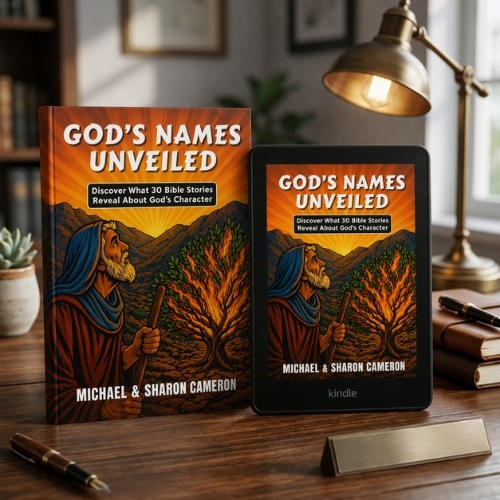
God’s Names Unveiled is a children’s book centered on the names of God found throughout Scripture. The Bible contains well over a hundred names and titles for God. In this book, we chose thirty of them and arranged them in the order they appear in Scripture. Each name is connected to a Bible story so children can not only learn the name itself but also understand the context in which God revealed it.
Each divine name reveals something precious about who God is. One name reveals His power. Another displays His compassion. Some highlight His holiness, faithfulness, wisdom, love, or provision. Every name shines light on another aspect of His glorious character. Of course, we will never fully comprehend God. He is infinite, eternal, and far greater than our understanding. Yet through His names, He graciously helps us know Him.
Perhaps the best way to picture this is to imagine a magnificent diamond. Each time you turn it, another ray of light flashes from its surface. Every angle reveals another glimpse of beauty. God’s names work in a similar way. Each one reflects another facet of His glory.
Why Knowing God’s Name Matters
The Bible says, “Those who know your name put their trust in you” (Psalm 9:10). It also says, “I will praise the name of God with a song” (Psalm 69:30). When we truly know God as He has revealed Himself, our hearts begin to change. We trust Him more deeply. We worship Him more sincerely. We obey Him more gladly. Over time, we begin to reflect His character in our own lives.
A.W. Tozer famously wrote, “What comes into our minds when we think about God is the most important thing about us.” We believe that statement is profoundly true—not only for adults, but for children as well.
“What comes into our minds when we think about God is the most important thing about us.”
Children are forming their understanding of God from a very young age. That is why we wanted to create a book that helps families slow down together and think carefully about who God is.
Our prayer is that God’s Names Unveiled will spark meaningful conversations around dinner tables, during family devotions, and at bedtime. More than anything, we pray it will help children not merely learn facts about God but come to enjoy and glorify Him more fully.
We Use the Form “Yahweh” in This Book
God’s personal name in the Old Testament is written using four Hebrew letters: YHWH. This sacred name appears nearly 7,000 times in the Hebrew Scriptures. In most English Bibles, it is translated as LORD in small capital letters.
Ancient Hebrew was originally written using only consonants. Vowel sounds (such as a, e, i, o, and u) were not included in the text. Instead, people learned pronunciation by listening to teachers and memorizing the words. Because of this, we cannot know with complete certainty today how God’s name was originally pronounced.
Many scholars and Christians believe the most likely pronunciation is Yahweh. Some Bible translations, such as the Legacy Standard Bible, use this form instead of translating the name simply as LORD. Other Christians prefer the form Jehovah, which has been widely used throughout church history. However, we have chosen to use the form Yahweh throughout this book when referring to God’s personal name. So, where some books may say Jehovah Jireh, we will use Yahweh Jireh.
We do not believe Christians should divide over the pronunciation of God’s name. What matters most is not the precise sound of the word, but what the name reveals about God Himself. When God revealed His personal name to Moses in Exodus 3, He was revealing His character, His faithfulness, and His eternal nature. He was showing Moses—and all His people—who He is.